
The Journal
How Light Rewrites Architecture
3D projection mapping for events is the technique of using precisely calibrated projectors to cast moving images, light, and narrative directly onto a physical surface (a building facade, a ceiling, or a custom-built structure) transforming how it reads in real time without altering the surface itself. The “3D” refers not to the imagery but to the mapping process: the surface is first modelled in three dimensions so the content conforms exactly to its geometry.
A building can stand for centuries and say the same thing. Projection mapping changes what it says in a single night.
Le Mariage has applied this discipline across some of the most demanding events in the Middle East, from a three-kilometer royal heritage facade in Bahrain to an 18,000-pixel kinetic light installation across seven thousand square meters in Riyadh. This is a complete guide to 3D projection mapping for events: what it is, how it works, and what it demands to be done at the level that defines it.
Light alone does not transform a space. The surface it falls on does.
3D projection mapping is the discipline of casting precisely calibrated digital content onto a physical surface — a building facade, a cathedral arch, a custom event structure — so that the surface itself appears to shift, move, and tell a story. The “3D” in the name refers not to the imagery but to the mapping process: the surface is first digitally modelled in three dimensions so the projected content conforms exactly to its shape, its recesses, its protrusions, and its architecture. The result is not a projection on a building. It is a building that appears to be alive.
This is what separates projection mapping from a conventional light show. A light show illuminates. Projection mapping transforms. The surface remains untouched, unchanged, exactly what it was. What guests see on it can be anything.
“A light show illuminates. Projection mapping transforms.”
The process that produces a seamless, large-scale projection mapping installation runs across four stages. Each must be complete before the next can begin.
Surface scanning and 3D modelling. The target surface is scanned and rendered as a precise three-dimensional digital model. Every architectural feature, every protrusion, every curve and recess is captured exactly, because any inaccuracy at this stage will propagate as visual distortion in the final installation.
Content creation mapped to geometry. The visual content — whether narrative, abstract, or structural — is designed inside the 3D model of the surface. It is not designed independently and then applied. It is built for the surface, so that a line of light traveling along the edge of an arch does so because the model told it exactly where that edge is.
Projector placement, calibration, and rigging. Projectors are positioned at distances and angles calculated from the 3D model, and each one is calibrated to its exact zone of the surface. Where multiple projectors overlap, edge-blending software creates a seamless join. The structural rigging that holds the projectors in position must be stable under the conditions of the environment — wind, vibration from crowds, or the precision requirements of a multi-projector array across three kilometers.
Real-time synchronization. In a live event environment, the projection synchronizes with lighting, music, and the choreography of the guest experience. For the installation Le Mariage engineered for Into Lumière in Riyadh, this synchronization was managed through a bespoke signal network built specifically for the project, allowing 18,000 individually addressed light points to respond as a single, coherent environment.
Projection mapping has moved well beyond the festival context where it first emerged. Today it is one of the defining tools of luxury event design, applied across a range of occasions that share one requirement: the environment must do more than impress. It must feel like somewhere no guest has been before.
Private celebrations and royal ceremonies use projection mapping to transform historic venues, palace halls, and bespoke event structures into environments that carry personal narrative. A reception hall can carry the story of a family legacy across its walls. An outdoor landscape can become the night sky.
Corporate launches and brand activations use it to place a brand narrative at architectural scale, making an entire building or event structure the delivery mechanism for a visual identity. No screen required. The building is the screen.
Cultural and heritage events use it at its most layered, where the physical surface itself carries historical meaning and the projection adds a contemporary voice without diminishing what the building already is. This is the most demanding application of the discipline, and the one Le Mariage built Art Nouveau around.
Festivals and large-scale public events use projection mapping at its most expansive — across multiple surfaces, across spans that require dozens of synchronized projectors, across nights that require stability in open-air conditions.

The engineering of a projection mapping installation changes entirely depending on whether it is applied to a building facade or an interior surface. Both are projection mapping. They are different disciplines.
Facade mapping operates at the scale of architecture. Projection distances are longer, typically tens or hundreds of meters. The ambient environment is open air, which means facade installations almost always take place after dark or in controlled twilight. The structural rigging must hold projectors stable against wind and weather at those distances. And a three-kilometer span, as Le Mariage mapped in Bahrain for Art Nouveau, requires not one projector but an array of them, each mapped to its section and synchronized into a single seamless whole.
Interior mapping operates at a more controlled but technically exacting scale. The distances are shorter. The ambient light can be managed. But the surfaces are often more complex — crossing structural elements, furniture, and the physical presence of guests. The 18,000-pixel installation Le Mariage built for Into Lumière in Riyadh across seven thousand square meters of interior space required a bespoke signal network to manage synchronization at that density within a single environment.
Both demand the same discipline: the structural engineering, the 3D mapping, and the content must be conceived as one project from the first day, not assembled separately and merged on site.

These are not competing technologies. They are different tools that solve different problems. The question an event designer asks is not which is better but which serves the story this space needs to tell.
Le Mariage has built both. Art Nouveau used projection mapping across a three-kilometer facade. Pearl Harmony used a 360-degree LED screen spanning eight meters in height and fifty meters in diameter inside Al Wajba Palace in Qatar. Each was the right answer for its surface, its environment, and its guest.
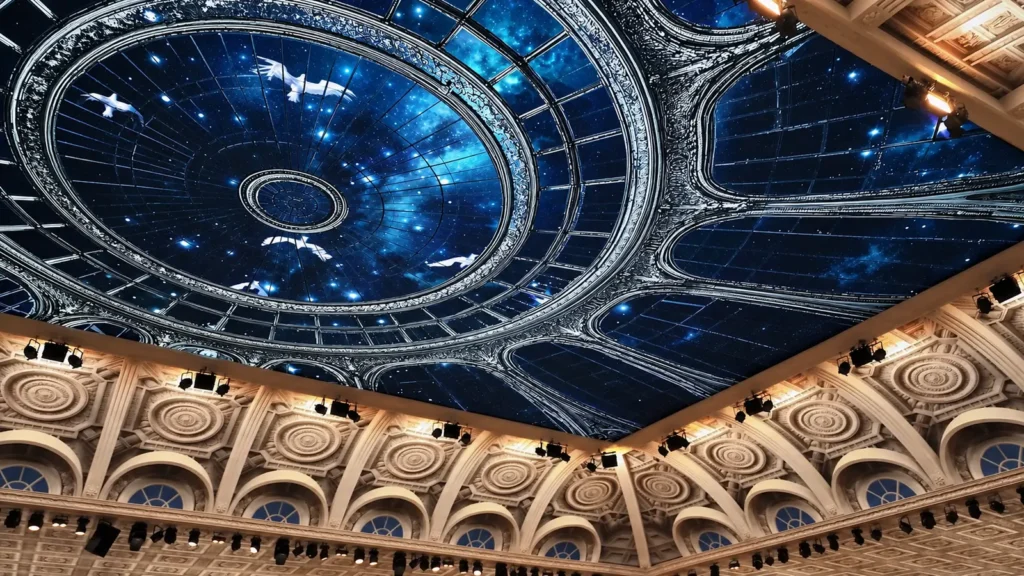
Three kilometers of Bahraini royal heritage. Thirty days. One of the most technically demanding projection mapping installations the Middle East has seen.
Art Nouveau in Bahrain was built around a single question: what happens when you take a building that already carries centuries of meaning and give it a new voice for one night? The answer — designed and built over thirty days — was a 3D projection mapping installation across the full length of the three-kilometer heritage facade, turning the architecture into a living narrative of Bahrain’s royal legacy. The structural rigging that held the projector array stable across that span was engineered in parallel with the content and the creative work from day one. Structure and imagery were conceived as one.
Into Lumière in Riyadh moved the discipline indoors. Seven thousand square meters at the Mandarin Oriental Hotel Faisaliya, built in nine days, anchored by an 18,000-pixel kinetic light system synchronized through a bespoke signal network engineered for the project. The light moved with the deliberateness of something alive. It was not a projection system performing in a room. It was the room.
Projection mapping at this level begins months before the event. The surface scan and 3D modelling must be completed well in advance of content production: an error in the model is an error in the final installation, and at scale, the margin for improvisation is zero.
The stages run in sequence with preparation work advancing in parallel. Surface scanning and modelling come first. Then content creation, designed for the specific geometry of the surface. Then projector specification and structural rigging design, resolved before fabrication begins. Then pre-production testing, off site where possible. Then on-site installation and calibration — the most time-compressed phase of the process, and the one guests see.
For a large-scale facade installation, conversations typically begin four to six months before the event date. For interior installations at a smaller scale, the timeline compresses, though the rigour of the modelling and calibration phase does not. Le Mariage completed Into Lumière’s interior installation in nine days. The nine days is the on-site phase. The months before it are where the precision actually lives.
↳ What Is Immersive Experiences? A Complete Guide — The discipline behind environments guests enter, not observe
↳ Luxury Event Design in the GCC: What Sets Elite Companies Apart — The five markers that separate category-defining studios from the field
↳ Art Nouveau — Bahrain 2024 — Three kilometers of heritage facade mapped in thirty days
↳ Into Lumière — Riyadh 2025 — 18,000 pixels, seven thousand square meters, nine days on site
↳ Explore the Full Le Mariage Portfolio — Sixteen landmark projects across the Middle East and beyond
↳ Begin the Conversation — Commission a projection mapping installation with Le Mariage
Projection mapping at this level is not a vendor decision. It is a design and engineering conversation.