
The Journal

Behind the FIFA World Cup 2022 Event Design

How Le Mariage Built 16 Luxury Lounges Across Qatar

In this Article

When the world’s biggest sporting event arrives, every space that surrounds the pitch carries its own weight. Le Mariage was entrusted with a commission that few design studios have ever faced: 16 bespoke VIP and VVIP lounges, across 8 stadiums, for an audience that included heads of state, football legends, and the most powerful names in global sport.

A Commission Unlike Any Other

The FIFA World Cup 2022 was the first World Cup held in the Arab world — and Qatar delivered it with an ambition that matched the occasion. Eight iconic stadiums rose across the desert: Lusail, Al Bayt, Khalifa International, Al Janoub, Ahmad Bin Ali, Al Thumama, Education City, and Stadium 974. Each was an architectural statement. Each demanded an interior to match.

Le Mariage — the Doha-based luxury event and design studio founded by Mohamad Ghayad in 2009 — was brought in to design the VIP and VVIP hospitality lounges that would host world leaders, royalty, football icons, and global brand executives across all eight venues. Sixteen lounges in total. One brief: create spaces where prestige is felt in every material, every line of light, every moment of arrival.

“Sixteen lounges. Eight stadiums. One standard: nothing short of world-class.”

What Le Mariage produced was not a repeated template applied across locations. It was a coherent design language — one rooted in Qatar’s cultural heritage — that adapted to the unique architecture and context of each stadium. This is the story of how that work was done.
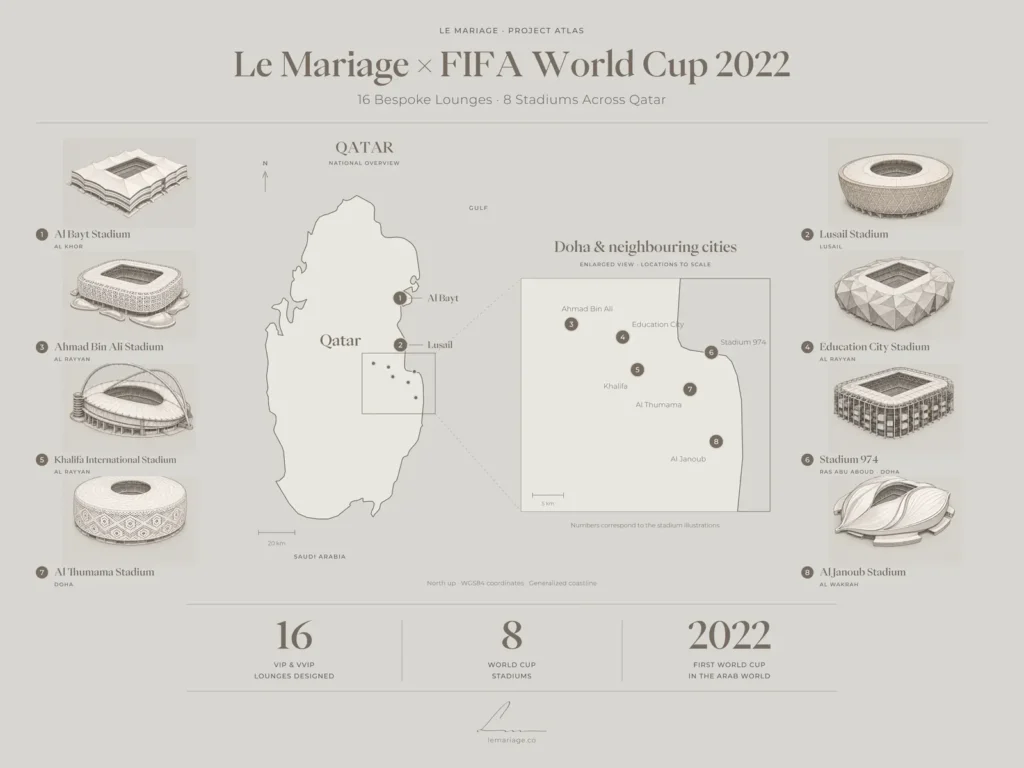
Le Mariage and the FIFA World Cup 2022: 16 bespoke lounges across 8 stadiums in Qatar

The Design Language: Qatari Heritage Meets Contemporary Luxury

Every Le Mariage project begins with a question: what does this place want to say? For the World Cup lounges, the answer was clear. Qatar was hosting the world, and every guest who walked through those doors would carry that experience home with them. The design had to be unmistakably Qatari, unmistakably world-class, and unmistakably Le Mariage.

The team drew from several pillars of Qatari visual and material culture:

  • Geometric pattern language — arabesque and mashrabiya-inspired motifs translated into bespoke wall panels, ceiling treatments, and flooring
  • Sand, stone, and pearl tones — a palette pulled from Qatar’s desert landscape, coastline, and traditional architecture — warm neutrals set against deep navy and burnished gold
  • Crafted material hierarchy — every surface selected for tactility — handwoven textiles, carved marble, brushed metal, and responsively lit glass
  • Cultural storytelling through lighting — dynamic lighting sequences that shifted in atmosphere from arrival to the match moment to reception, narrating the experience through light

The result was a family of interior environments — related by language but differentiated by stadium, by function, and by the tier of guest each space was designed to serve.

VIP vs. VVIP: Two Tiers, Two Entirely Different Experiences

One of the defining challenges of this commission was the distinction between VIP and VVIP hospitality, not just in protocol, but in design intent. While both tiers demanded exceptional quality, the experiential logic of each was fundamentally different.
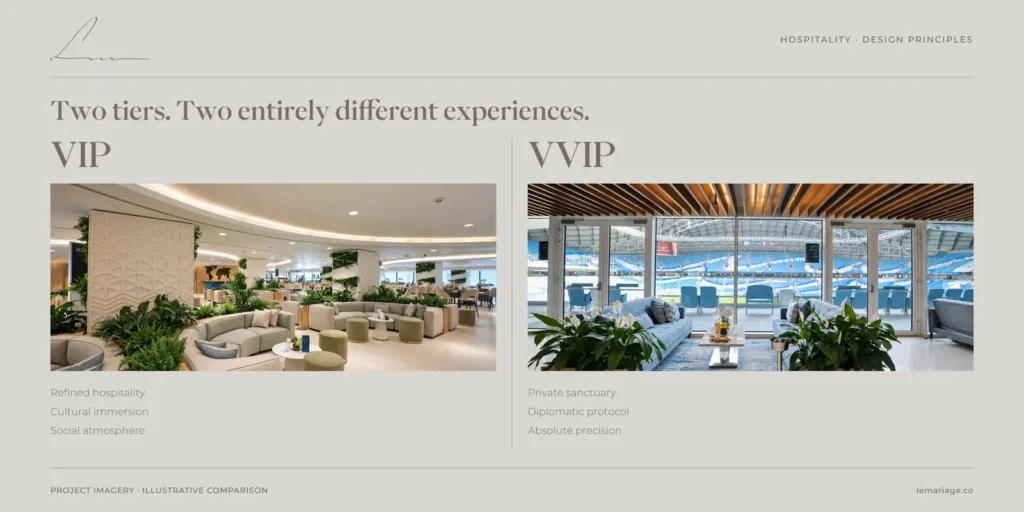
VIP vs. VVIP Lounge Design: Key Distinctions

VIP and VVIP lounge design compared: two tiers, two entirely different experiences
Design DimensionVIP LoungeVVIP Lounge
Primary IntentRefined hospitality at scale — comfort and status signalling for a larger guest groupPrivate sanctuary — designed for intimate protocol, political dignity, and absolute discretion
ScaleLarger footprint with flexible zoning for dining, networking, and stadium viewsCompact, controlled environments — dedicated entry, antechamber, and private viewing
Material SpecificationPremium — marble, curated upholstery, custom joinery, bespoke lightingExceptional — hand-selected stone, museum-grade art objects, couture-level textile and finish specification
Lighting DesignLayered ambient and accent — event-responsive mood shiftsFully programmable scene sequences — arrival, reception, match, and departure each carry a distinct light signature
Service FlowPre-designed service choreography integrated into the spatial planProtocol-sensitive spatial sequencing — movement paths, sightlines, and service access designed around diplomatic requirements
Cultural ExpressionQatari motifs and material palette — guests feel the host nation’s identity at every touchpointDeep cultural narrative — specific references to Qatari heritage, story, and aspiration woven into spatial and object design
Artwork & ObjectsCurated statement pieces aligned with the overarching design languageBespoke, commissioned pieces — objects that cannot be replicated or sourced elsewhere
Acoustic DesignEngineered for social atmosphere — managed noise and crowd energyPrecision acoustic shielding — private conversation remains entirely private

The distinction mattered because the guest experience is entirely different. A head of government arriving at a VVIP lounge is not simply seeking comfort — they are operating within a formal diplomatic context where every spatial decision communicates something. Le Mariage understood this, and the spatial choreography of each VVIP environment reflected it.

Executing Across Eight Stadiums: The Operational Challenge

Designing one exceptional hospitality space is one thing. Designing sixteen across eight active construction sites — with different structural constraints, different orientation and natural light conditions, and a live-event deadline that could not move — is another order of challenge entirely.

Le Mariage’s ability to deliver this commission came down to three capabilities that define the studio:

  1. Architectural fluency. The Le Mariage team approaches every project as a work of architecture first — understanding structure, load, services integration, and the relationship between a designed space and its host building. At each stadium, the team worked directly from architectural drawings, adapting the lounge designs to the specific shell and conditions.
  2. Systems-based production. Custom elements — joinery, metalwork, bespoke lighting fixtures, textile panels — were produced simultaneously across multiple fabrication partners, with a logistics system that tracked delivery, installation sequence, and quality sign-off for each of the sixteen spaces.
  3. On-the-ground presence. The Le Mariage installation team operated across all eight stadiums during the final fit-out period, with a shared quality standard that ensured the sixteenth lounge was finished to exactly the same benchmark as the first.

This is what separates an event design studio from an event architecture firm. Le Mariage does not hand off to contractors. The same creative vision that originates the design carries through to the final adjustment of a wall panel on installation day.

The Outcome: Spaces That Held the World’s Gaze

When the FIFA World Cup 2022 opened on November 20, 2022, more than three billion people around the world tuned in. The guests in those sixteen lounges — royalty, heads of government, sports federations, global brand executives, football legends — experienced Qatar through the spaces Le Mariage created.

For Le Mariage, this project confirmed what the studio had always believed: that great event design is never just aesthetic. It is a form of national storytelling. It is an act of hospitality at the highest level. And when it is done with precision, with cultural intelligence, and with genuine architectural rigour, the space itself becomes part of the legacy of an event.

The FIFA World Cup 2022 commission stands alongside Le Mariage’s other landmark projects — the IN TIME wedding in New Delhi, the Art Nouveau projection mapping in Bahrain, the Royal Wedding in Riyadh — as proof that the studio operates in a category of its own: large-scale, high-stakes, immersive event architecture, executed with flawless precision. See the full FIFA World Cup 2022 project.

About Le Mariage

Le Mariage is a luxury event architecture and design studio based in Doha, Qatar. Since 2009, the studio has designed and built immersive environments for royal families, heads of state, global corporations, and the world’s most prestigious events — across Qatar, Saudi Arabia, the UAE, India, and beyond.

Explore More From Le Mariage

Frequently Asked Questions

Who designed the VIP and VVIP lounges at the FIFA World Cup 2022 in Qatar?

Le Mariage — the Doha-based luxury event architecture studio — designed 16 bespoke VIP and VVIP hospitality lounges across all 8 FIFA World Cup 2022 stadiums in Qatar. Founded by Mohamad Ghayad in 2009, Le Mariage was commissioned to create immersive, culturally rooted environments for world leaders, football legends, royalty, and global brand executives attending the tournament.

Le Mariage designed 16 lounges in total — two per stadium (one VIP, one VVIP) — across all eight World Cup venues: Lusail Stadium, Al Bayt Stadium, Khalifa International Stadium, Al Janoub Stadium, Ahmad Bin Ali Stadium, Al Thumama Stadium, Education City Stadium, and Stadium 974.

In professional event design, the distinction between VIP and VVIP goes far beyond access tier. A VIP lounge serves a larger, premium guest group — it prioritises elevated comfort, refined material quality, cultural expression, and managed social atmosphere. A VVIP lounge, by contrast, is a private, protocol-sensitive environment designed for heads of state, royalty, and similarly elevated guests. It prioritises discretion, spatial sequencing for diplomatic movement, acoustic shielding, bespoke commissioned objects, and lighting scenes that shift with the protocol demands of the event. The two require fundamentally different design thinking — and Le Mariage has the expertise to deliver both simultaneously.

Le Mariage grounds every project in a deep reading of the host culture. For the FIFA World Cup 2022 commission, this meant drawing directly from Qatar’s visual and material heritage: arabesque geometric pattern language adapted into bespoke architectural elements; a material palette of sand, stone, pearl, and burnished gold drawn from Qatar’s desert and coastal identity; crafted textiles referencing traditional Qatari weaving traditions; and lighting sequences that echoed the play of light across water and sand — the defining natural experiences of the peninsula. The result was a design language that felt unmistakably Qatari while meeting the most demanding international hospitality standards.

Yes, and the FIFA World Cup 2022 is the clearest demonstration of that capability. Delivering 16 finished environments across 8 active construction sites, on a fixed international deadline, requires architectural discipline, precision logistics, and a production system that can operate across multiple locations simultaneously. Le Mariage maintains complete design and production oversight from concept to installation, which is what makes simultaneous multi-venue commissions possible at this quality level.

Le Mariage has always operated at the intersection of event architecture, immersive experience design, and luxury hospitality — and this applies far beyond weddings. The studio’s portfolio includes major international sporting events (FIFA World Cup 2022, FIFA Arab Cup 2025), large-scale immersive cultural experiences (IN TIME 2023 in New Delhi, Art Nouveau 2024 in Bahrain), Ramadan hospitality environments (Leilah 2024 and 2025, Oumsiyah 2026), royal and state ceremonies in Saudi Arabia and Qatar, and festival and exhibition design. Any event requiring precision design, immersive environment creation, and large-scale execution is within Le Mariage’s scope.

A commission of this scale — 16 spaces, 8 venues, full bespoke specification — requires 12 to 18 months of active design and production time in advance of the event date. This accounts for concept development, client approvals, bespoke fabrication lead times, logistics coordination, and on-site installation across multiple venues. For time-critical or protocol-sensitive commissions, early engagement with the studio is essential. Le Mariage recommends initial contact as early as 18–24 months before the event for commissions of this scale and complexity.

Global events introduce a specific design challenge: the audience arrives from dozens of countries, each carrying different aesthetic references, spatial expectations, and cultural sensitivities. Le Mariage navigates this by designing from the inside out — starting always with the host culture and the specific emotional experience the client wants to create, then layering in a design language with sufficient depth, craft quality, and visual intelligence to resonate across cultural contexts. The goal is never to homogenise into a neutral international style, but to create something so rooted in its place and vision that it commands universal respect and recognition.