
The Journal
Le Mariage's IN TIME Installation in New Delhi
Land art is the discipline of treating the land — or a designed outdoor environment — as both the canvas and the material. Not a backdrop for an event. Not a venue that receives a design. The environment itself is the work. IN TIME, Le Mariage's commission in New Delhi, is the clearest contemporary example of what this means at event scale: one hundred and twenty-two thousand square feet of sculpted landscape, fractal geometry, and architectural intervention, built in sixty days.
India hosts eight to ten million weddings annually — the world's largest wedding market, valued at approximately one hundred and thirty billion dollars. At the tier this article is concerned with, the shift is decisive: the expectation is no longer for an event in a space. It is for a world built for an event. IN TIME was commissioned at exactly the point where that expectation became the brief.
Land art — also known as earth art or earthworks — is an art practice in which the landscape itself is the medium of the work. Its form, material, and spatial logic are not the setting for the art. They are the art. The practice emerged as a formal movement in the late 1960s and early 1970s, associated with artists like Robert Smithson, whose Spiral Jetty reshaped a section of the Great Salt Lake in Utah into a coiled earthwork fifteen hundred feet long. The work did not sit in the landscape. It was the landscape.
What Le Mariage brought to IN TIME is this discipline applied to a different context: a temporary commission, built to receive guests and produce an experience, but designed with the spatial intelligence and structural ambition of a land art project rather than a conventional event. The term is not borrowed for effect. It is the accurate description of how the commission was conceived — with the ground itself, its geometry, its elevation, and its relationship to the built structures above it, as the primary design material.
A standard event design fills an outdoor space. Land art at event scale redesigns it — the topography, the geometry, the movement paths, the relationship between structure and landscape, and the experience of moving through a world that has been made rather than found. For a fuller account of what this discipline looks like in structural and architectural terms, see our guide to luxury event architecture.
The difference between a land art commission and a conventional outdoor event is the same difference as between designing a building and decorating a room. Both happen at the same address. Only one changes the address itself.
For a more detailed account of how immersive technology and architectural design operate together within this discipline, see our comparison of immersive event design vs traditional events.
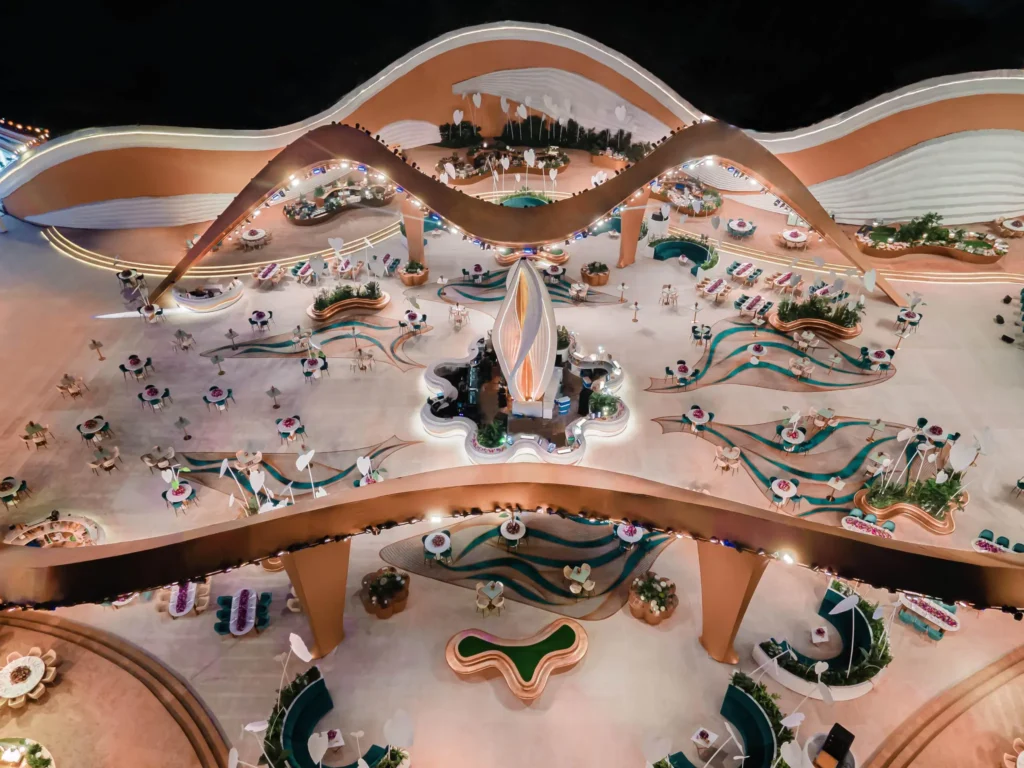
One hundred and twenty-two thousand square feet. Sixty days. The largest LED screen in history.
These three facts define IN TIME before any description of what guests experienced. The commission was not a wedding that happened to be held outdoors. It was a land art environment designed to host a wedding — an outdoor world of fractal geometry, sculpted landscape, and architectural intervention, conceived and built by Le Mariage in New Delhi.
The design language of IN TIME drew from a vocabulary of precision and futurism rather than from cultural ornamentation. Dynamic fractal geometries — mathematical forms that repeat at different scales, the same structural logic present in a small detail and in the overall environment simultaneously — provided the spatial vocabulary of the entire site. Futuristic structures rose from the sculpted ground in patterns that directed movement, created distinct zones, and produced the visual rhythm that defined what guests saw and felt from arrival to departure. The geometry was not ornamental. It was structural. It generated the experience.
Not a wedding with a theme. A world built for a wedding.
At the centre of IN TIME stood the commission's most technically singular element: a monumental stage supporting the largest LED screen in history at the time of its construction. One hundred metres wide and twenty-four metres high, the screen transformed the landscape behind it into a canvas of light, movement, and storytelling visible across the full expanse of the one hundred and twenty-two thousand square foot environment. The screen was not placed in the design. It was the culminating element of the architecture that everything else was oriented toward.
Sixty days of on-site construction to produce a designed landscape of this scale required Le Mariage's complex structural design and immersive experience design practices to run in parallel from the first day — structural fabrication, landscape engineering, and LED content production not as a sequence but as a coordinated build. This is the same production discipline that delivered sixteen FIFA World Cup VIP and VVIP lounges across eight stadiums in Qatar in twenty days, and a three-kilometre royal heritage facade projection in Bahrain in thirty days. Sixty days for one hundred and twenty-two thousand square feet of land art is not a slow build. It is the speed at which this scale of work can be done without compromising the standard.
India's wedding industry is valued at approximately one hundred and thirty billion dollars annually. India hosts eight to ten million weddings per year — the world's largest wedding market. At the tier IN TIME occupies — multi-day, multi-event, large guest counts with serious design ambition — the shift is fully underway: toward events that are not simply grand but designed, immersive, and architecturally considered. IN TIME was commissioned at this inflection point.
What distinguishes India's top-tier events from the Gulf is not scale or ambition — both markets produce commissions of comparable weight. It is the design vocabulary. GCC royal events draw from the visual heritage of the Gulf: geometric pattern language derived from Arabic architectural tradition, a material palette of sand, pearl, and burnished gold, ceremonial protocol that shapes the architecture. IN TIME drew from a different register — precision, futurism, mathematical geometry — the design language of a culture with its own deep relationship between pattern, structure, and space. Le Mariage translates its architectural discipline across both markets, which requires understanding each one from within rather than applying a single aesthetic across different addresses.
Le Mariage — the Doha-based event architecture studio founded by Mohamad Ghayad in 2009 — has designed large-scale events across Qatar, Saudi Arabia, Bahrain, and India. IN TIME represents the studio's international reach and the portability of its architectural discipline across markets that share ambition but not context. With offices in Doha, Dubai, and Paris, the studio has completed more than one hundred and fifty commissions over sixteen years. For an account of how these design disciplines compare to conventional event production, see our piece on immersive event design vs traditional events.