
The Journal
The Art of Luxury Floral Installations
A floral installation is not a larger version of a floral arrangement. It is a different discipline entirely — one that begins with the space rather than the flower, and ends with an environment rather than a decorated surface. Luxury floral services grew twenty-eight percent in 2024 while standard florists grew three percent. That gap reflects a structural shift in what clients at the highest level now expect: not flowers that accompany an event, but flowers that are the event.
Le Mariage — the Doha-based event architecture studio founded by Mohamad Ghayad in 2009 — designs floral installations that operate at the scale the discipline was built for. The Al Khayat Wedding in Doha, 2024, used four million flowers across twelve thousand square metres not as decoration, but as the primary architectural material of the entire environment.
This article covers what makes a floral installation architectural, what that looks like at royal and palace scale, and what the production of a commission like the Al Khayat Wedding actually requires.
A floral installation is a spatial design element — a structure, surface, or environment composed of flowers — whose purpose is to define or transform the character of a space, rather than to decorate objects within it. The distinction sounds subtle. In practice, it determines everything: the studio, the timeline, the engineering, and what guests experience when they walk through the door. Le Mariage's floral art sculptures practice operates at this architectural level — designing flower-based environments that belong to the discipline of spatial design, not event styling.
Three characteristics define a floral installation as distinct from a floral arrangement.
Scale is the first. An installation does not sit on a surface — it occupies the space itself. A ceiling that spans a full hall, a wall of living flowers that defines the entry to a ceremony, an aisle canopy that guests walk beneath rather than look at from a distance. The flowers are not placed in the room. They are the room.
Structural logic is the second. Every large-scale floral installation has an engineered support system: custom metalwork, rigging infrastructure, hanging points calibrated for the specific weight and density of the bloom specification. This is not a vase filled with water. It is a load-bearing structure designed by engineers and fabricated before a single stem is ordered.
Spatial intent is the third. A floral installation changes how the space feels, how guests move through it, and what they remember when they leave. The flowers are the medium. The experience is the output. At the Al Khayat Wedding in Doha, Le Mariage used four million flowers not as decoration but as the primary architectural material of a twelve-thousand-square-metre environment.
The distinction between a floral arrangement and a floral installation is structural, not aesthetic. One decorates a surface. The other redesigns the space.
When floral architecture is combined with immersive technology — programmable lighting, 3D projection mapping, kinetic installations — the environment moves into a different category entirely. For a fuller account of how these disciplines intersect, see our piece on immersive event design vs traditional events.
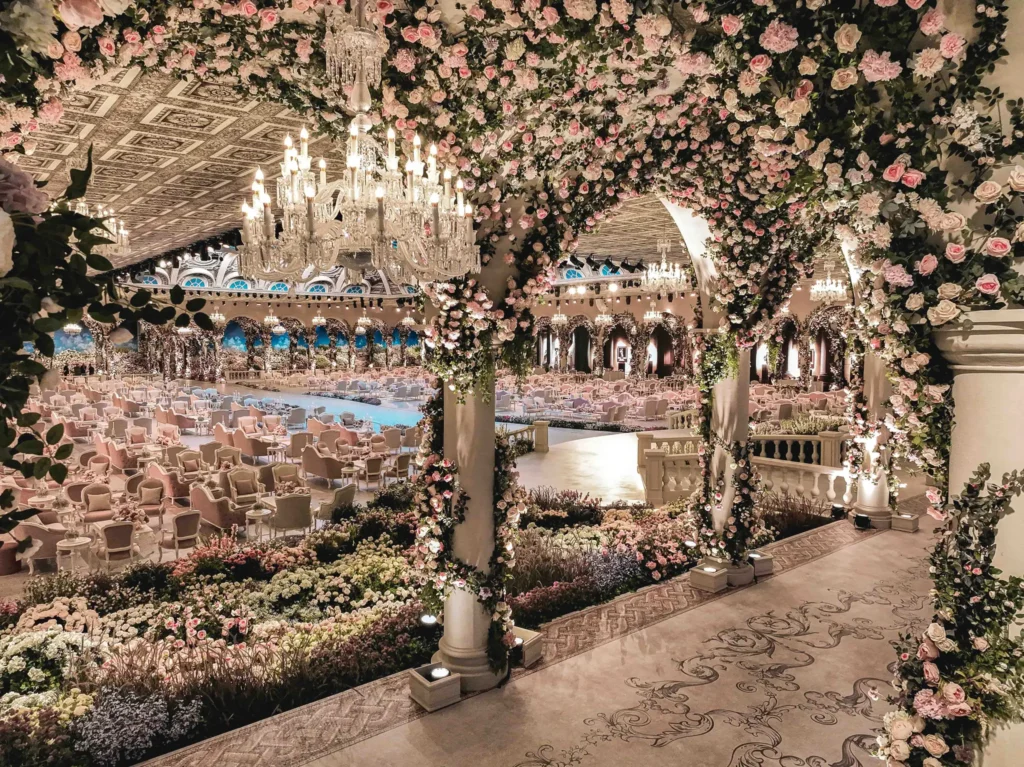
Four million flowers. Twelve thousand square metres. One wedding.
The Al Khayat Wedding, Doha 2024, was not designed with flowers in mind and architecture as an afterthought. The commission was designed as an architectural environment in which flowers were the primary structural material. Every ceiling element across twelve thousand square metres was composed of living blooms. Every spatial division that guided five thousand guests through the reception — the pathways, the zones, the transitions between ceremony and dinner and dancing — was defined by flowers rather than by walls or partitions. The Kosha, the bridal stage at the focal point of the women's reception, was not a stage decorated with flowers. It was a structure built of them.
The floral palette was built around white and ivory roses, peonies, and ranunculus — chosen not only for their aesthetic quality but for their structural behaviour at scale. Dense-headed blooms that hold their form under the weight and heat conditions of a large event, sourced in the volumes required through coordinated procurement across multiple Dutch auction channels and air freight schedules that ran for months ahead of the event date.
At this scale, flowers are not counted by stem. They are specified by structural zone.
The ceiling installation — the most architecturally significant element — required a bespoke metalwork framework engineered to carry the weight of millions of blooms at height across the full span of the hall. The rigging was not designed after the floral scheme was drawn. The structural engineering and the floral design were developed together, because the frame had to be built with exactly the right mounting density, load tolerance, and spatial geometry to support the specific installation above it.
For a fuller account of what designing an environment at this scale requires across architecture, technology, and ceremony, see our guide to how to design a royal wedding.
A commission of the Al Khayat Wedding's scale does not begin with flowers. It begins with structural engineering.
The frames, rigging systems, and ceiling infrastructure are designed and fabricated first — months before a stem is ordered. This is the point at which the commission crosses from floral design into event architecture, and it is the point at which the interior design and fit out discipline and the floral practice operate as one. The structural team and the floral team are not working in sequence. They are working from the same set of drawings, from the first day.
Flower orders for a large-scale installation are locked three to four weeks before the event date, coordinated around Dutch flower auction schedules and air freight windows. Premium blooms — roses, peonies, ranunculus, orchids — are imported through specialist logistics networks, with arrival sequencing designed so each variety reaches peak bloom condition at the moment of installation rather than at the moment of ordering. The flowers placed last are the ones guests see first. That sequence is planned precisely.
On-site, the physical installation of a large suspended floral ceiling requires twenty-four to forty-eight hours of continuous work. Teams operate in zones: structural team first, completing and signing off each section of the framework; floral teams following in choreographed sequences behind them, working inward from the perimeter so the final installation point is the centrepiece that all sightlines converge on.
Freshness at this scale is an engineering problem as much as a horticultural one. Climate-controlled storage and transport, on-site hydration systems built into the structural frame, and the precise timing of the installation sequence relative to the event itself — these are the things that determine whether four million flowers look alive when the doors open. Nothing in this process is improvised. The flowers placed at hour forty-eight have been in transit, conditioning, and installation for the same carefully managed period as the ones placed at hour one.
In Qatari and Gulf weddings, floral design has always operated at a different scale from Western traditions. The Kosha — the bridal stage and its surrounding architectural structure — is the focal point of the reception and traditionally carries the highest-density floral specification in the entire event. In large royal or palace-scale weddings, this is not a stage with flowers around it. It is a structural environment built of flowers, and it sets the visual and spatial standard that every other element in the room is measured against.
The scale of ambition that GCC royal events generate — twelve thousand square metres, three to seven days of celebrations, guest counts of five hundred to five thousand — produces commissions that define what is technically and aesthetically possible in floral architecture. The volume of high-specification large-scale work in this region has no parallel anywhere else. Floral architecture as a discipline has been pushed further, faster, in the Gulf than in any comparable market, because the commissions demand it.
There is also a cultural dimension that shapes the material language of GCC floral design. The palette of white, ivory, and pale gold roses that dominated the Al Khayat Wedding references the pearl and cream tones of Qatari and Gulf heritage — the coastline, the traditional dress, the architecture of historic buildings. The scale references something else: the ambition and generosity that define the most significant celebrations in this culture. Flowers at this density are not excess. They are an expression of what the occasion means.
Le Mariage — the Doha-based event architecture studio founded by Mohamad Ghayad in 2009 — has designed floral environments at this scale for royal families and private clients across Qatar, Saudi Arabia, and Bahrain. The Al Khayat Wedding is the studio's most cited floral commission: four million flowers, twelve thousand square metres, one environment. Le Mariage has completed more than one hundred and fifty projects over sixteen years, serving royal families and private clients across the Gulf. The studio's floral art sculptures practice sits within a broader capability that includes complex structural design, immersive experience design, and interior design and fit out — which is what makes a commission of the Al Khayat Wedding's scale possible.